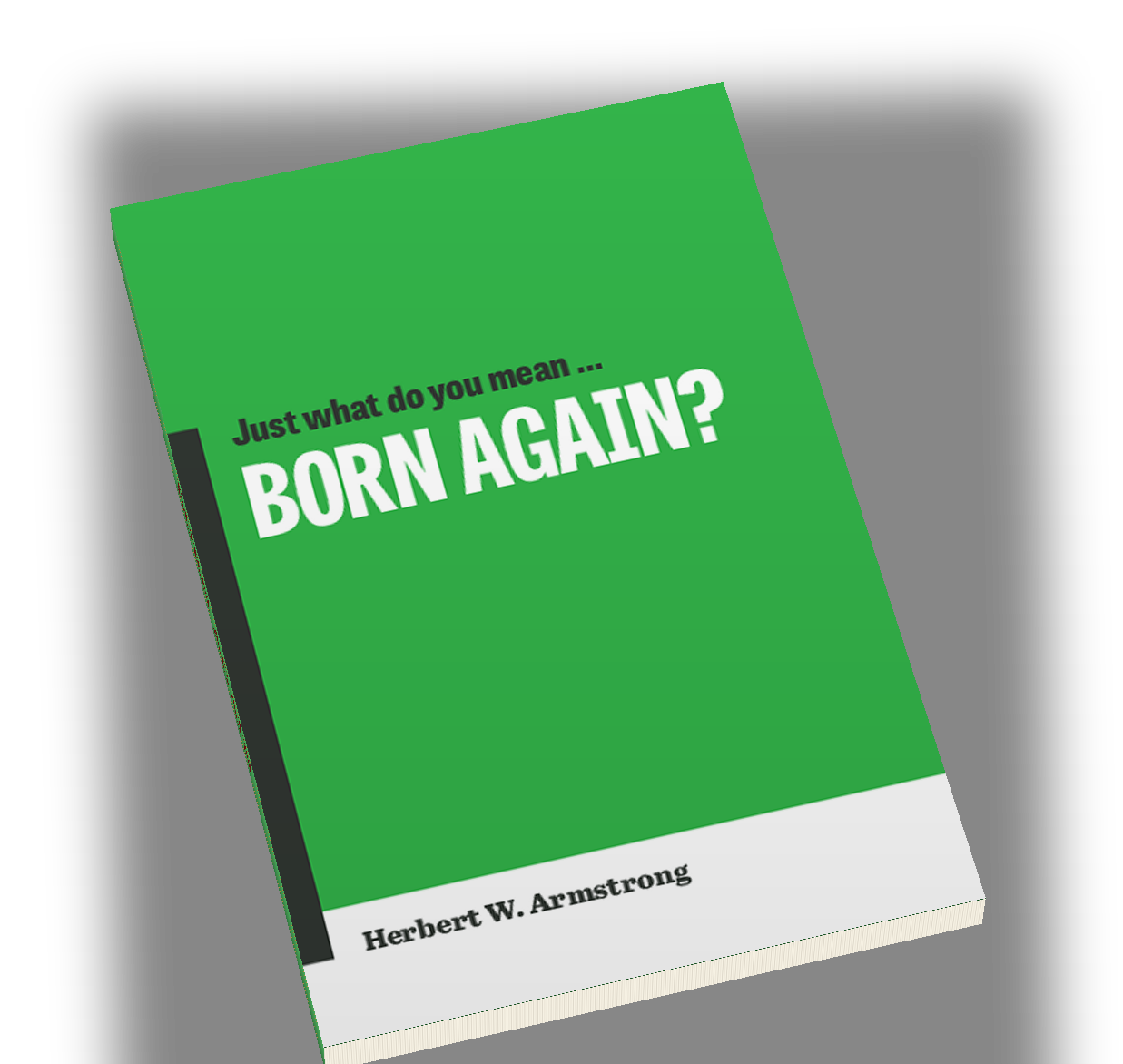
"The Christian churches misuse this phrase. What did Jesus Christ actually mean?"
My friends, let me be plain with you. Ask any ten of your neighbors what "born again" means, and nine will describe an emotional moment — a raised hand at a revival, a tearful altar call, a warm feeling of being "saved." That is the answer nearly every church in America has taught for a hundred years. But it is not what Jesus Christ answered when a puzzled Pharisee came to Him by night.
Nicodemus was no ordinary man. John 3:1 calls him "a ruler of the Jews" — a member of the Sanhedrin, the ruling seventy of Israel. Jesus later addresses him as "a master of Israel" (John 3:10) — THE teacher, the theologian's theologian. And yet, when Christ uttered those two words, this brilliant Pharisee was so bewildered he stammered: "How can a man be born when he is old? can he enter the second time into his mother's womb, and be born?" (John 3:4).
Do you see what has happened, my friends? Nicodemus took Jesus at His word. He understood plainly that Christ meant a literal, physical birth — and that was so staggering he could scarcely believe his ears. Modern Christianity has softened the meaning down to a feeling because the real meaning is even more staggering than what Nicodemus imagined.
Herbert W. Armstrong recovered that lost meaning in this booklet. He proves — not from human tradition, not from a creed, not from a denominational catechism, but from your own Bible verse by verse — that "born again" is not a warm feeling you can experience next Sunday. It is a literal, breathtaking, promised transformation that God has scheduled for a definite day in your future.
To be "born of the Spirit" is to be composed of spirit — even as one born of flesh is composed of flesh. Christ's contrast in John 3:6 is not poetic. It is a plain statement about composition.
When you were born of your mother, you emerged composed of flesh — skin, blood, bone. To be "born again," Jesus said, is to emerge composed of spirit. And you have never yet seen a person who is composed of spirit walking the streets of your city. Not one.
That is why Mr. Armstrong wrote in Just What Do You Mean … Born Again?: the New Testament describes a person "in Christ" today not as one who has been born again, but as one who has been begotten of God — spiritually conceived, impregnated with the Holy Spirit, waiting through a lifelong gestation for the day of actual birth. The apostle Paul writes plainly of that day: "Behold, I shew you a mystery; We shall not all sleep, but we shall all be changed, In a moment, in the twinkling of an eye, at the last trump: for the trumpet shall sound, and the dead shall be raised incorruptible, and we shall be changed" (1 Corinthians 15:51-52).

"Flesh and blood cannot inherit the kingdom of God" (1 Corinthians 15:50). Read those words carefully. Flesh cannot. Not "should not." Not "will not." Cannot.
A physical, mortal, flesh-and-blood human being is composed of the wrong substance to enter God's Kingdom — just as a fish, composed of the wrong substance for the atmosphere, cannot inhabit the sky. Something must first happen to the flesh: it must be changed. And Paul tells us plainly when that change happens — "at the last trump" — at the resurrection of the dead in Christ.
This is why Christ used the astonishing analogy of the wind in John 3:8: "The wind bloweth where it listeth, and thou hearest the sound thereof, but canst not tell whence it cometh, and whither it goeth: so is every one that is born of the Spirit." Those actually born of Spirit are, like the wind, invisible — not composed of the flesh your eyes can see, but of Spirit itself. That is the mystery Mr. Armstrong unlocks, verse by verse, in this booklet.
Just What Do You Mean … Born Again? is not a booklet of denominational speculation. Every point is proven directly from your own Bible. Here is a portion of what you will learn:
Why Nicodemus, the most respected Bible teacher of his day, was baffled by Christ's answer — and why nearly every modern preacher misses the same point.
The Greek word gennao and how the New Testament carefully distinguishes between spiritual conception now and literal spirit-birth at the resurrection.
Christ's own definition, spoken to Nicodemus in John 3:6 — a statement about the very composition of a resurrected saint.
What Paul's astonishing prophecy in 1 Corinthians 15 tells us about the moment when mortal puts on immortality.
Why the Kingdom of God is a ruling divine Family — and how a converted human is destined to be born into it.
How the church at large came to reduce Christ's staggering promise to an emotional experience — and what has been quietly lost.
This booklet was first published in 1962 and revised into the 1980s. Herbert W. Armstrong was not a theologian by trade. He was an advertising man who came to the Bible late in life — and asked the question honest men had stopped asking: what if the plain words of Christ mean exactly what they say?
Beginning in 1934 with a single 100-watt radio broadcast, Mr. Armstrong built a Work that reached every corner of the globe. The Plain Truth magazine climbed to a circulation of over 8 million copies. Thirty printings and millions of booklets of The United States and Britain in Prophecy went out from Ambassador College at Pasadena.
Just What Do You Mean … Born Again? was one of his earliest doctrinal booklets — and one of the most quietly discarded after his death in 1986. The full text has been recovered and preserved by the Philadelphia Church of God under Gerald Flurry. It has never been for sale. Not now, not then, not ever.
"For as many as are led by the Spirit of God, they are the sons of God… joint-heirs with Christ; if so be that we suffer with him, that we may be also glorified together" (Romans 8:14, 17).
Consider the words. Joint-heirs with Christ. Consider what Christ has inherited. Consider what will be shared, forever, with a converted human being who has passed through the change from mortal to immortal, from flesh to spirit. This is why the apostle John wrote: "Beloved, now are we the sons of God, and it doth not yet appear what we shall be: but we know that, when he shall appear, we shall be like him; for we shall see him as he is" (1 John 3:2). This staggering promise is what those two words — born again — were always meant to unlock.
Herbert W. Armstrong opened Christ's midnight answer to Nicodemus and let the plain words of Scripture stand on their own — chapter by chapter, every point proved directly from your own Bible, no denominational spin, no charge, no follow-up. Read it with your Bible open in the other hand and see what those two words were always meant to mean.
Request Your Free CopyOpens the free order page at TheTrumpet.com. No cost. No obligation. Ever.
Whatever else you take from this page, take this: the words of Jesus Christ are not vague. They are not spiritualized metaphors for a warm feeling. They are the plain announcement of a literal event that God has scheduled — and the greatest gift ever offered to a human being.
Read the booklet. Prove it from your own Bible. Then decide what you will do.
Request Your Free Copy Now
“Where are your dead relatives right now? Heaven? Hell? Purgatory? Or a fourth answer, straight from your Bible?”

“Are America and Great Britain named in the prophecies of your Bible?”

“You’ve read those words a hundred times. Do you know when they mean?”